
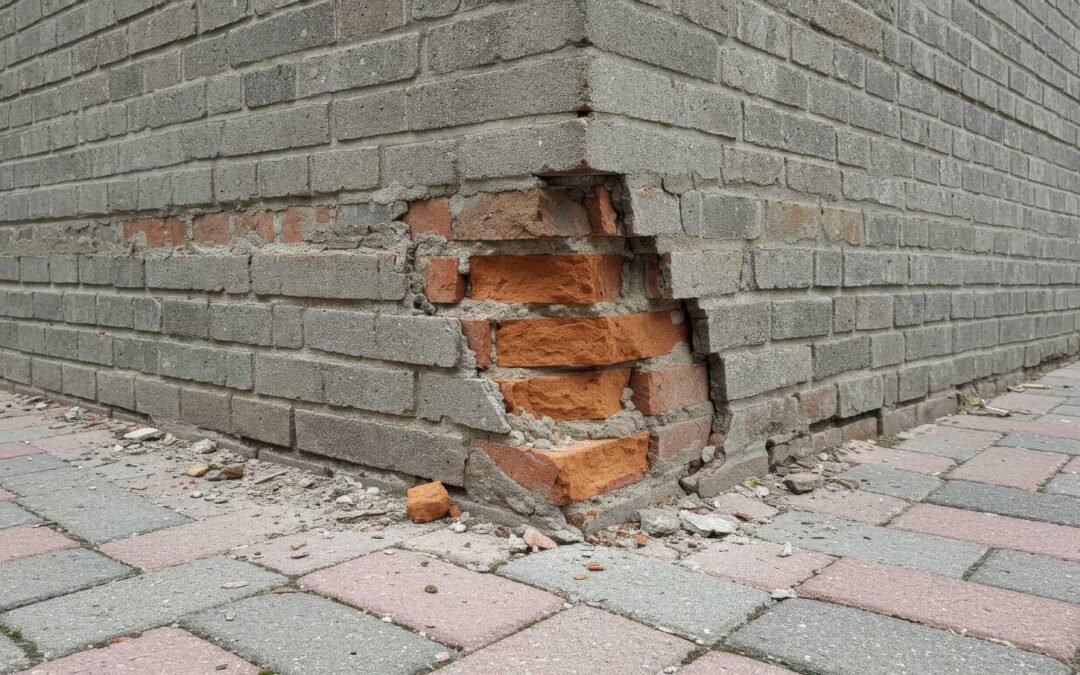
Professional foundation repair services in Boston require specialized stabilization for timber pile-supported brownstones, rubble stone basements, and Boston Blue Clay settlement zones. Effective repair uses structural underpinning, Natural Hydraulic Lime restoration, and engineered groundwater protection to preserve historic buildings safely.
Boston Foundation Repair Requires Historic Structural Expertise
Foundation failure in Boston is never just a cracked basement wall.
It is often the visible symptom of a much deeper structural issue involving reclaimed land, marine clay, deteriorating timber piles, groundwater decline, and incompatible past repairs.
Historic Masonry Contractors provides advanced foundation repair services in Boston for Back Bay brownstones, Beacon Hill townhomes, South End multi-family properties, North End masonry buildings, and East Boston commercial structures. Our work combines structural engineering, geotechnical analysis, and historic preservation to stabilize foundations without compromising architectural integrity.
Unlike modern suburban homes built on predictable poured concrete systems, many Boston buildings rely on 19th-century timber pile foundations, granite block footings, lime mortar rubble stone walls, and masonry systems that behave very differently under load.
Repairing them requires precision not generic concrete patchwork.
From Commonwealth Avenue to Charles Street, from Copley Square to the streets below Storrow Drive and the Charles River Basin, our foundation specialists restore structural performance while protecting Boston’s historic built environment.
The Subsurface Challenge Beneath Boston
Boston is a city literally built on changed geography.
More than 5,250 acres of tidal marshes, mudflats, and coastal lowlands were filled during the 18th and 19th centuries to create neighborhoods including Back Bay, the South End, Fenway, parts of the Financial District, and sections of the waterfront.
These filled lands were created using:
- gravel
- imported sand
- demolition debris
- ash
- marine silt
- loose urban fill
This reclaimed land was never naturally stable enough to support heavy multi-story masonry buildings.
Builders solved this by driving untreated timber piles typically spruce and pine deep through the fill and soft marine deposits until they reached dense glacial till or competent bearing layers.
Above those piles sat massive granite caps, followed by brick masonry walls and brownstone façades.
That system worked remarkably well.
As long as groundwater remained high.
The 2026 Groundwater Emergency: Why 6,000 Buildings Are at Risk
Boston’s foundation crisis is now a citywide structural issue.
In 2026, current monitoring estimates show that more than 6,000 historic buildings across Boston are actively at risk of timber pile deterioration caused by dropping groundwater levels.
On March 18, 2026, the city formally recognized this issue by declaring the date Boston Groundwater Trust Day, honoring four decades of subsurface monitoring and groundwater protection led by the Boston Groundwater Trust.
This is not symbolic.
It reflects a major preservation emergency affecting some of Boston’s most valuable historic real estate.
The Boston Groundwater Trust continues to monitor observation wells and piling maps across vulnerable neighborhoods including Back Bay, South End, and Beacon Hill through its official groundwater monitoring network: Boston Groundwater Trust
How Timber Pile Foundations Fail
Timber piles do not fail because they are old.
They fail because oxygen reaches them.
The Preservation Principle
Wood piles remain structurally sound for centuries when permanently submerged below the groundwater table.
This is because submerged conditions create an anaerobic environment.
Without oxygen:
- fungi cannot grow
- decay bacteria cannot thrive
- wood fibers remain intact
- compressive strength remains stable
This is why 150-year-old timber piles can still perform perfectly today.
The Failure Mechanism
When groundwater drops below the pile cut-off elevation, the top of the timber becomes exposed to oxygen.
This exposure triggers:
- fungal colonization
- microbial decomposition
- fiber degradation
- reduced cross-sectional capacity
- uneven load transfer
- differential settlement
Common causes include:
- deep sewer trenching
- leaking municipal infrastructure
- transit tunnel construction
- basement dig-down projects
- adjacent excavation
- poor stormwater recharge
- improper sump discharge
- excessive impervious paving
Once pile heads begin to rot, granite caps settle, brick walls crack, and the building begins to move.
This is why a Back Bay brownstone may suddenly develop sloping floors and stair-step brick cracks while appearing “fine” for decades beforehand.
Boston Blue Clay: The Hidden Geotechnical Problem
Below the reclaimed fill lies one of Boston’s most significant geotechnical challenges: Boston Blue Clay.
Boston Blue Clay is a dense marine clay deposit formed after glacial retreat. It is moisture-sensitive, compressible, and highly responsive to changes in stress and loading.
Its engineering behavior directly affects foundation performance.
Why Boston Blue Clay Causes Settlement
Boston Blue Clay behaves differently than stable bearing soils because:
- consolidation occurs slowly over time
- moisture changes alter shear strength
- surcharge loads create delayed settlement
- excavation changes lateral pressure
- groundwater infiltration softens the matrix
In practical terms, one side of a building may settle faster than another.
This differential movement creates:
- stair-step cracking in brick joints
- bowing foundation walls
- misaligned windows and doors
- warped floor systems
- separated party walls
- shifting lintels and arches
This is especially common in South End and Back Bay buildings that were never designed for rooftop additions, heavy renovations, or deep basement excavation.
Rigid patch repairs often make the problem worse.
Proper repair requires load redistribution—not cosmetic crack filling.
Why Modern Concrete Can Damage Historic Foundations
One of the most common repair failures in Boston is the misuse of Portland cement.
Many older buildings in Beacon Hill, North End, and East Boston sit on:
- rubble stone foundations
- granite block footings
- fieldstone basements
- soft lime mortar wall systems
These were never designed for modern dense concrete.
Portland Cement Problems
Portland cement is:
- rigid
- dense
- vapor impermeable
- stronger than historic masonry
- incompatible with flexible stone systems
When used on old foundations, Portland cement traps moisture inside the original masonry.
During freeze-thaw cycles, trapped water expands.
The result:
- spalling stone
- fractured brick
- outward wall pressure
- cracked granite joints
- accelerated foundation deterioration
This is why “quick concrete repairs” often create major long-term damage.
Natural Hydraulic Lime (NHL): The Correct Preservation Solution
Historic foundations need breathable repair systems.
That means Natural Hydraulic Lime (NHL), not modern Portland cement.
Why NHL Works
NHL mortar is:
- vapor permeable
- flexible under movement
- chemically compatible with historic masonry
- capable of controlled moisture migration
- appropriate for granite and rubble stone systems
It allows the wall to breathe and move naturally with seasonal settlement.
This protects the original structure instead of fighting it.
Our restoration process includes:
- petrographic mortar analysis
- custom mortar matching
- NHL repointing
- low-pressure lime grout injection
- internal void stabilization
- granite block foundation reinforcement
Preservation is not stronger materials.
It is compatible materials.
For historic masonry guidance and preservation standards, the U.S. National Park Service provides reference preservation briefs here: National Park Service Preservation Briefs
Structural Underpinning Boston MA
When timber piles or footings are compromised, underpinning becomes necessary.
This is not standard basement work.
It is controlled structural surgery.
Our Traditional Underpinning Process
1. Precision Investigation
We perform:
- laser settlement mapping
- test pit excavation
- borescope pile inspection
- granite cap exposure
- groundwater review using BGwT well data
2. Temporary Structural Shoring
Needle beams, hydraulic jacks, and engineered cribbing temporarily support the building.
3. Removal of Decayed Timber Tops
Only the deteriorated upper timber section is removed.
We cut below the lowest historic groundwater line where submerged timber remains sound.
4. Structural Steel Sistering
Steel sleeves, H-piles, or transfer caps are installed over the preserved timber section.
This creates a new compression path.
5. Concrete Encasement
High-strength low-shrink structural concrete forms a permanent transfer block.
6. Controlled Load Transfer
Hydraulic jacking carefully returns the building load to the new support system.
This method preserves viable submerged timber while restoring full structural stability.
It is the gold standard for Back Bay wood piling repair.
Massachusetts foundation compliance follows 780 CMR structural standards: Massachusetts State Building Code – 780 CMR
Helical Piers for Boston Blue Clay Foundation Settlement
Not every structure uses timber piles.
For modern additions, concrete foundations, and severe clay settlement zones, helical piers are often the best solution.
Why Helical Piers Work
They provide:
- minimal vibration installation
- reduced risk to adjacent historic structures
- deep load transfer below unstable soils
- reliable bearing in glacial till or bedrock
- immediate structural stabilization
Unlike traditional driven piles, helical piers are installed with low-vibration hydraulic torque systems critical in dense urban neighborhoods like Beacon Hill and the North End.
Neighborhood-Specific Foundation Repair Services in Boston
Back Bay (02116)
Commonwealth Avenue, Marlborough Street, and Beacon Street are classic timber pile territory.
Our work focuses on:
- wood piling repair
- groundwater stabilization
- brownstone underpinning
- granite cap preservation
Beacon Hill (02108)
Steep glacial topography and historic district controls require precision.
We restore:
- rubble stone basements
- retaining wall foundations
- granite footings
- limited-access structural settlement zones
Historic district review often requires coordination with the official Boston Landmarks Commission Historic District Guidelines
South End (02118)
Settlement, basement water intrusion, and pile degradation are common along Tremont Street and Columbus Avenue.
We provide:
- structural underpinning
- NHL mortar restoration
- moisture management systems
- foundation stabilization for multi-family buildings
North End
Older brick footings and marine exposure require salt-resistant preservation methods and advanced masonry crack repair.
East Boston
High groundwater and waterfront soils demand specialized concrete stabilization and crack control systems.
Foundation Repair FAQs
How do I know if my Boston building has foundation problems?
Warning signs include sloping floors, stair-step brick cracks, sticking windows, gaps between walls and floors, sinking front steps, and basement wall movement.
In Back Bay and South End, these often indicate timber pile deterioration—not normal settling.
Why is Boston Blue Clay dangerous for foundations?
Because it expands, contracts, and consolidates over time. This creates uneven movement and long-term differential settlement that damages masonry walls and structural framing.
Why can’t I use regular concrete on my old stone foundation?
Because Portland cement traps moisture and causes freeze-thaw damage. Historic granite and rubble stone systems require breathable NHL mortar for proper long-term performance.
How much does foundation repair cost in Boston?
Localized lime mortar repairs may range from $15–$30 per square foot. Major underpinning and timber pile stabilization projects commonly range from $150,000 to $300,000+ depending on access and structural complexity.
Do I need permits?
Yes. Structural foundation work typically requires ISD permits and, in historic districts, review through the Boston Landmarks Commission.
Boston Historic Foundation Restoration Starts with Correct Diagnosis
Historic Masonry Contractors provides foundation repair services in Boston where preservation and structural engineering must work together.
Whether your property sits near Copley Square, along the Charles River Basin, beside Boston Common, or beneath the shadow of Beacon Hill’s historic masonry streetscape, the solution must fit Boston’s actual subsurface conditions.
Not generic concrete.
Not cosmetic patchwork.
Real structural preservation.
That is how historic Boston foundations are protected for the next century.